
Legal Scenario
Ashley McDonald
Introduction
In this chapter you will be presented with a legal scenario from a potential client. The purpose of this scenario is to learn how to gather evidence from the client in order to conduct legal research to answer the legal question at hand.
Legal Scenario
Your law firm has been approached by a 25-year-old potential client, currently a student at MacEwan University, who has a complaint about receiving a distracted driving ticket. The client explains that on October 16, they were driving northbound on Stony Plain Road at approximately 8:30 a.m. The client was running late for their university class and was due to write a midterm that morning. They quickly checked their phone to see if they had received any email notifications from their professor, as they had emailed them before leaving their house to explain that they would be a few minutes late for the midterm. The client then further explained that after quickly checking their phone, they were pulled over by an Edmonton Police officer. The client explained the situation to the police officer, but was charged with distracted driving under section 115.1(1)(a) of the Traffic Safety Act and issued a $287 distracted driving ticket and three demerits on their license. The client explained that they had only turned their phone on for a brief second to check if they had received a notification from their professor about being late for the midterm. They stated they were following the speed limit and not driving recklessly.
The client believes it is unfair that they received a harsh fine and demerits on their license, as they only checked their phone for a few seconds, and that the police officer acted unfairly. The client wishes to fight their ticket.
Factual Analysis
After listening to the client explain their situation and gathering all the facts, the next step is to identify the legal research that needs to be conducted and develop a plan for that research. Following the method suggested by Blatt and Kurtz (2020), the following relevant facts can be gathered.
- What are the legally relevant facts? The who, what, when, and where of the client’s claim.
- Who: A 25-year-old MacEwan University student and an unnamed police officer are involved.
- What: The client was pulled over for using their phone while driving and was charged with distracted driving under section 115.1(1)(a) of the Traffic Safety Act.
- When: The incident occurred on October 16, at 8:30 a.m.
- Where: The client was pulled over while driving on Stony Plain Road heading toward MacEwan University in Edmonton.
- What is the client asking?
- The client wants to fight their distracted driving ticket as they believe the fine of $287 and three demerits on their license is too harsh of a penalty. They want to either lessen the penalty or abolish it altogether.
- What area of law is relevant to the issue?
- It is quasi-criminal, specifically, traffic.
- What legal issues have been identified? What keywords help to conclude this?
- The legal issue concerns distracted driving, specifically whether briefly looking at, or holding, your phone constitutes a distracted driving violation.
- The key words in the client’s statement used to identify this legal issue are distracted driving, phone, ticket, and holding.
- What is the objective of the legal research task?
- To identify if the client has a defence to their distracted driving ticket.
- Are there any hidden issues that need to be addressed? Is any further information required?
- What were the police officer’s observations, and in what context? Could they see through the window from their vehicle or sidewalk (if applicable)?
- What were the weather and traffic conditions at 8:30 a.m. on Stony Plain Road where the incident took place?
- What kind of vehicle was the client driving?
- Did the officer lose sight of the individual at any point, considering the traffic conditions? (For example, were the vehicles at a standstill during rush hour, or were they moving consistently, and were there multiple vehicles similar to the client’s on the road?)
It is essential to address the underlying issues before proceeding to the next step. To verify the above information, additional interviews with the client may be necessary. In this scenario, we are defending the client. As a result, we must obtain all officers’ notes from the incident that led to the issuance of the violation ticket, also known as disclosure from the Crown Prosecutor’s Office. From there, we must review the police officer’s notes to determine what a potential defence might be for the client. After reviewing the police officer’s notes, it was found that the police officer was standing on the sidewalk and had been tasked with specifically looking for distracted drivers. Additionally, his notes state that it was a clear morning with no visibility issues resulting from the weather when looking for distracted drivers. Furthermore, despite the timing of 8:30 a.m. on a school day, the traffic was relatively light, with only a few cars on the road. The client’s red Maserati vehicle was easily distinguishable from other vehicles in the officer’s sight. The officer was able to clearly see the client holding their cellphone through the windshield of the vehicle, prompting them to flag the client over for distracted driving. This information is important because it provides additional details that were necessary for us to understand the incident and its surrounding circumstances more comprehensively. We now know that the officer had no visibility issues on the morning of the incident and was directed to screen for distracted drivers. Therefore, the officer was seeking clear signs of a driver engaging in an act that might constitute distracted driving.
At this point, it is beneficial to create a list of the facts that have been gathered so far. Review the facts in the table below.
| Table 9.1 Facts Relating to the Case |
| 1. The individuals involved are a 25-year-old MacEwan University student and an unnamed police officer. |
| 2. The client was pulled over for using their phone while driving and was charged with distracted driving. |
| 3. The incident occurred on October 16 at 8:30 am. |
| 4. The client was pulled over while driving on Stony Plain Road heading towards MacEwan University in Edmonton. |
| 5. The police officer was standing on the sidewalk and was tasked to specifically look for distracted drivers. |
| 6. It was a clear morning with no visibility issues resulting from the weather when looking for distracted drivers. |
| 7. The traffic was relatively light, with only a few cars on the road. |
| 8. The client’s red Maserati vehicle was easily distinguishable from other vehicles in the officer’s sight, and they were able to clearly see the client holding their cellphone while driving. |
After gathering and organizing the relevant facts of the case, the next step is to frame the legal issue. McCarney et al. (2016) suggest the best approach is to frame the legal issue as a question and to apply the law to the facts of the case. In this particular scenario, the relevant law governing the case is the prohibition on using a cellphone while driving under the Traffic Safety Act. We then need to apply this law to the facts of the case. With all of this information in mind, the legal issue can be framed as follows:
Whether the client is guilty of distracted driving under s. 115.1(1)(a) of the Traffic Safety Act for holding their phone while driving a motor vehicle on the highway.
You must frame the legal issue before you start your research, as this will help narrow the scope of the research that needs to be conducted. It is also important to use concise language in the legal issue, as this will help to identify what factors you are looking for, and if there are cases that have similar facts. After the legal issue is identified, the next step is to begin the research process using legal databases such as CanLII or Westlaw.
Legal Research
Now that the legal issue has been identified, the next step is to conduct legal research. One way to begin legal research is to start by using CanLII as it is a free, open resource. It is also important to note that when relying on primary sources the source must be accessible to everyone.
An initial search in CanLII of “Distracted Driving and Alberta” can be helpful to start the search for primary sources. Boolean operators are also a great tool to use when conducting research and can help to narrow or widen your results. Boolean operators are discussed in detail in an earlier chapter. After entering this into the CanLII search bar, you can specify your search to look at cases or legislation. From here, I would click on legislation so that we can learn more about Alberta’s rules on distracted driving.
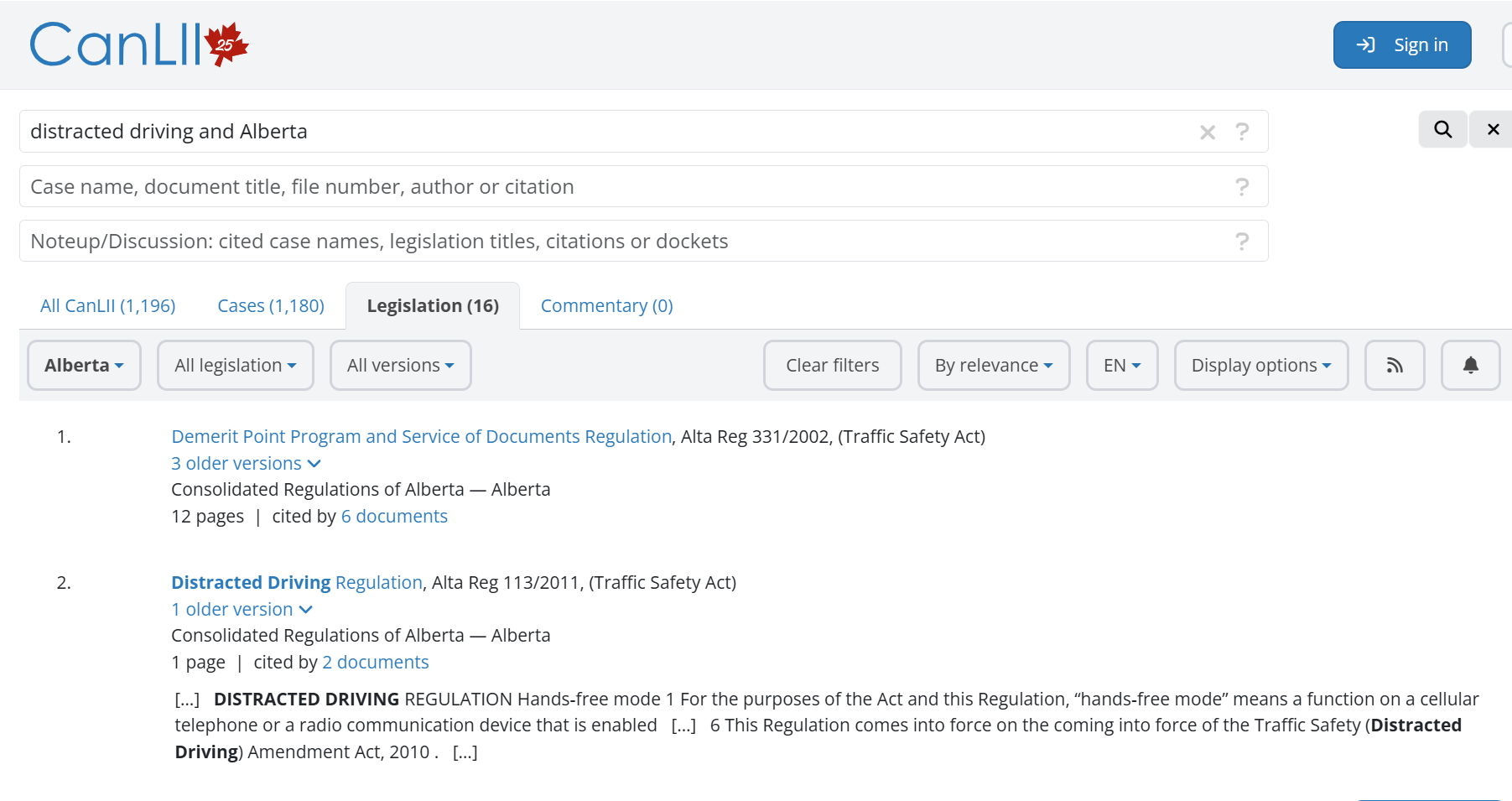
By scrolling through the links that appear, it is evident that the Traffic Safety Act is a recurring piece of legislation. The next step would be to review the Traffic Safety Act and determine if it contains any information on distracted driving laws in Alberta. Scrolling down the same page, it can be seen that there is a link to the Traffic Safety Act.
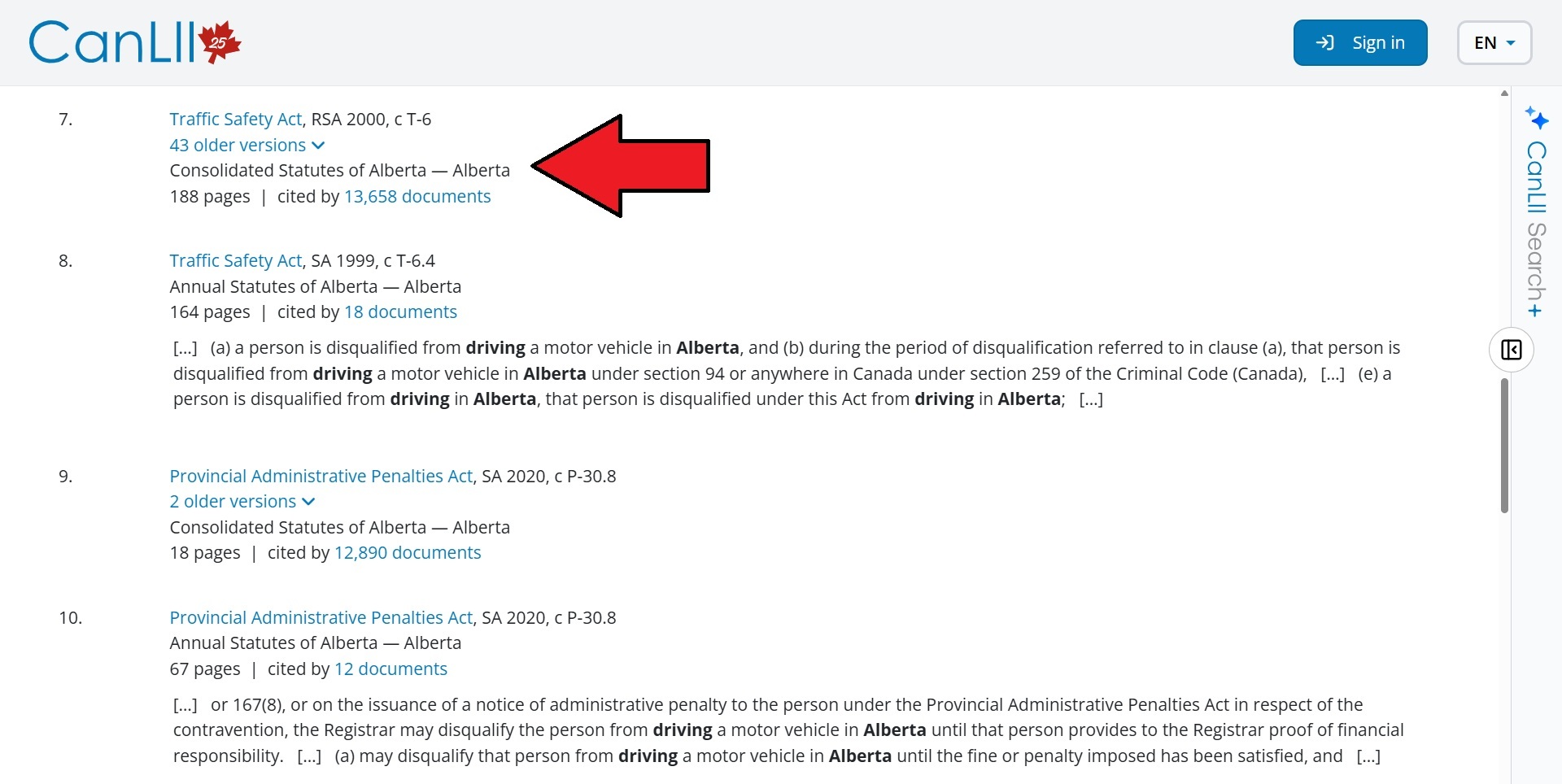
The link should then take you to the Traffic Safety Act, RSA 2000, c T-6. Tip: Make sure to check that you have the correct jurisdiction for the location of the offence.
Once on this screen, you can review the legislation and find the information you need on what Alberta considers distracted driving. One of the easiest ways to look for information within a long document is to use the “Find in Document” function on CanLII.
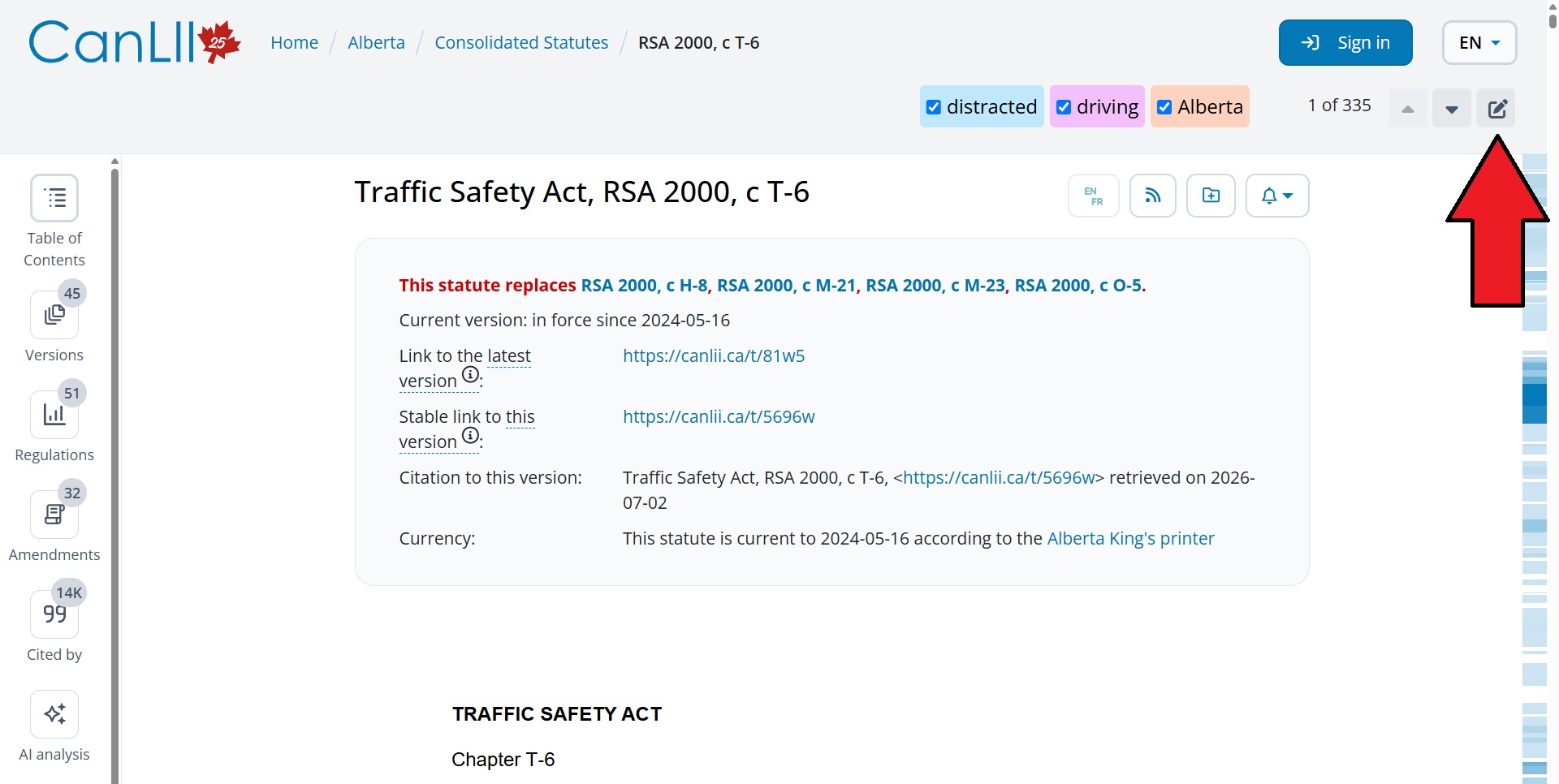
Once you click on this icon, it will give you a search bar that will allow you to type in keywords to help narrow your search. Tip: Make sure to spell the word you are looking for correctly; otherwise, it will be unable to find the keyword you are looking for.
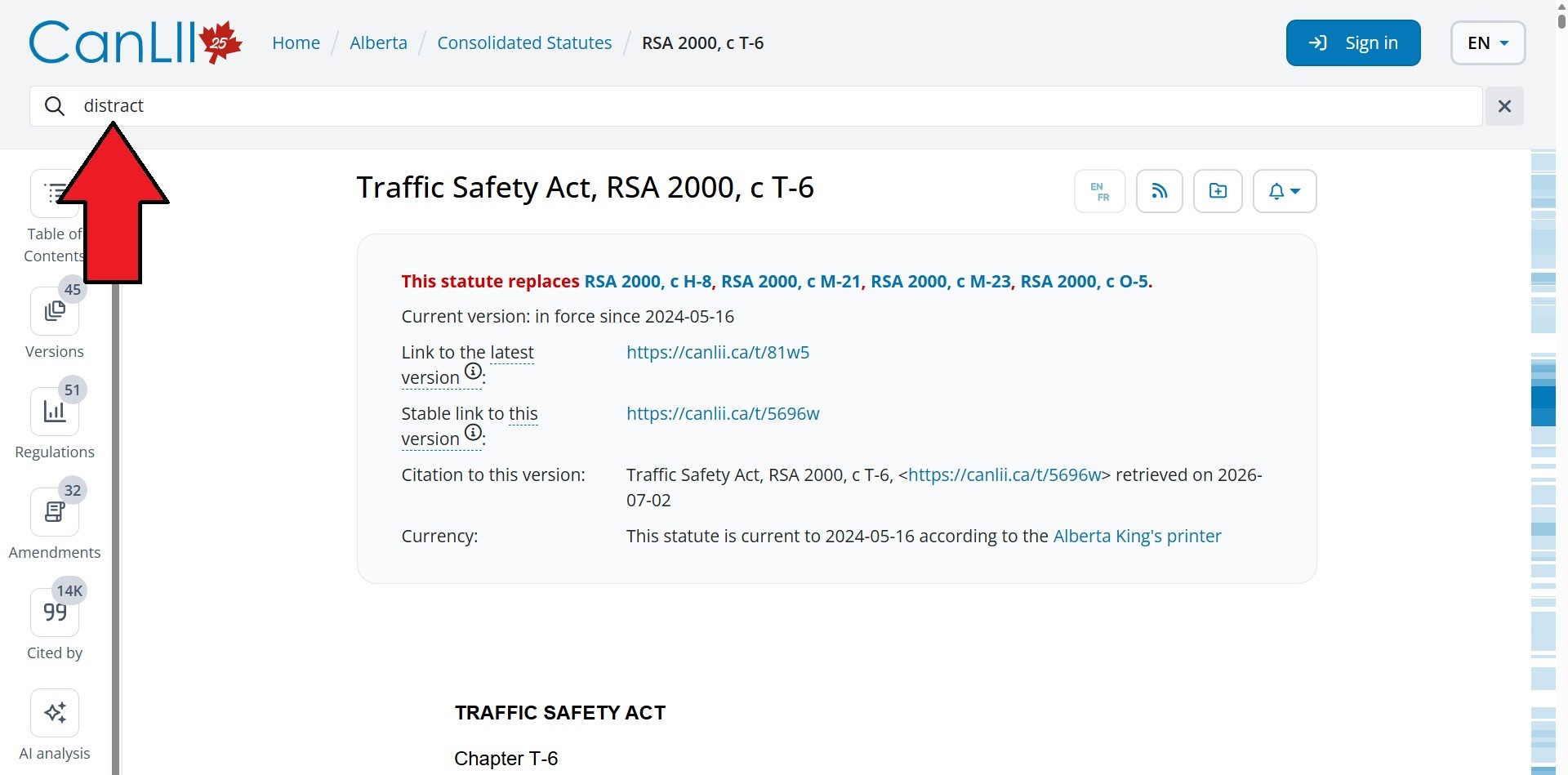
Typing the word “distract” into the search bar has a few results. Scrolling through the results, by using the arrows, leads to Section 115, which discusses the prohibited operation of vehicles.
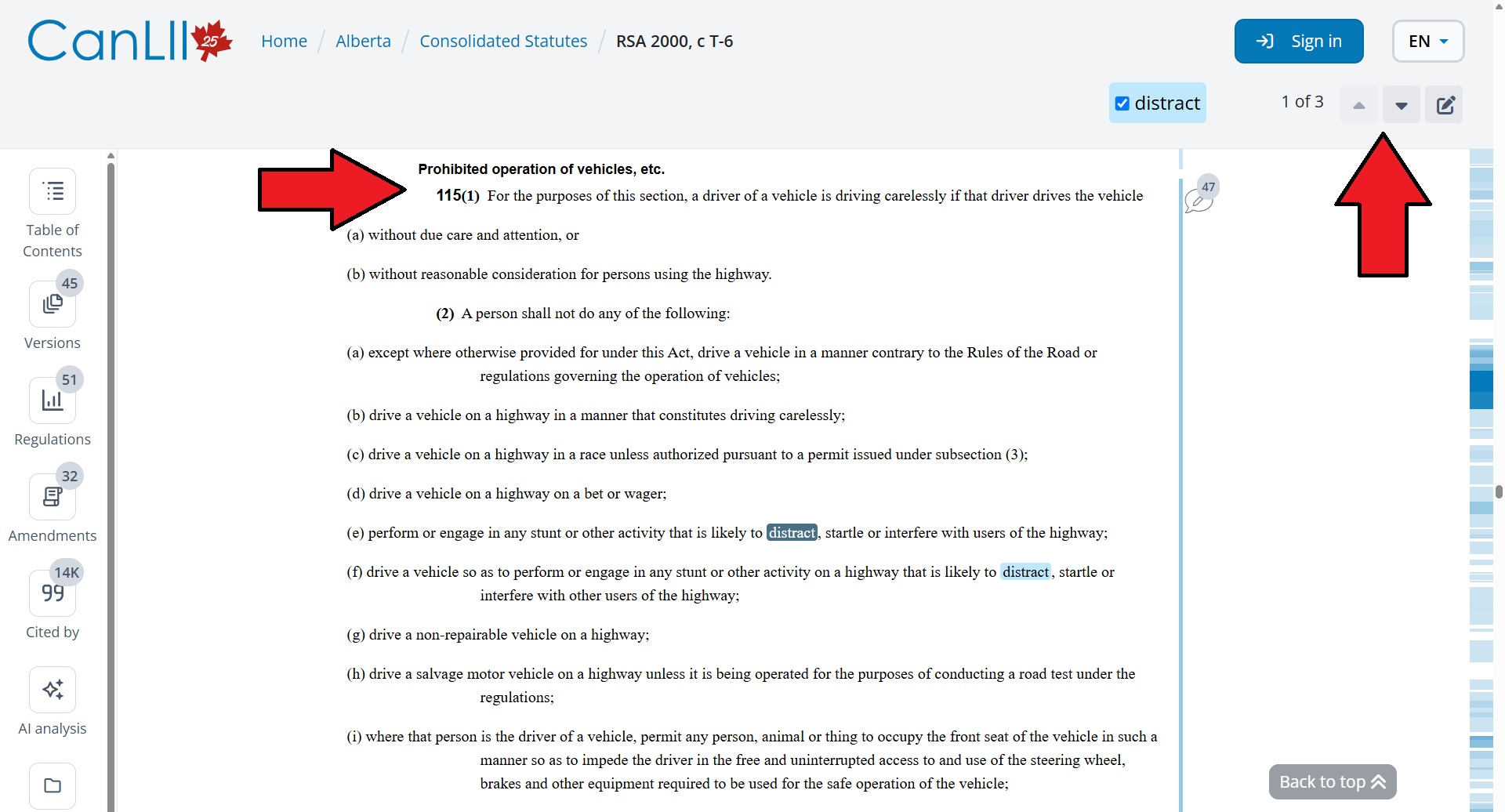
Scrolling through this section, it lists many different reasons for what is considered reckless driving. Further down, there is a section on the use of cellular telephones. Section 115.1(1)(a) states that no person is allowed to operate a vehicle while simultaneously “holding, viewing, or manipulating a cellular telephone.”
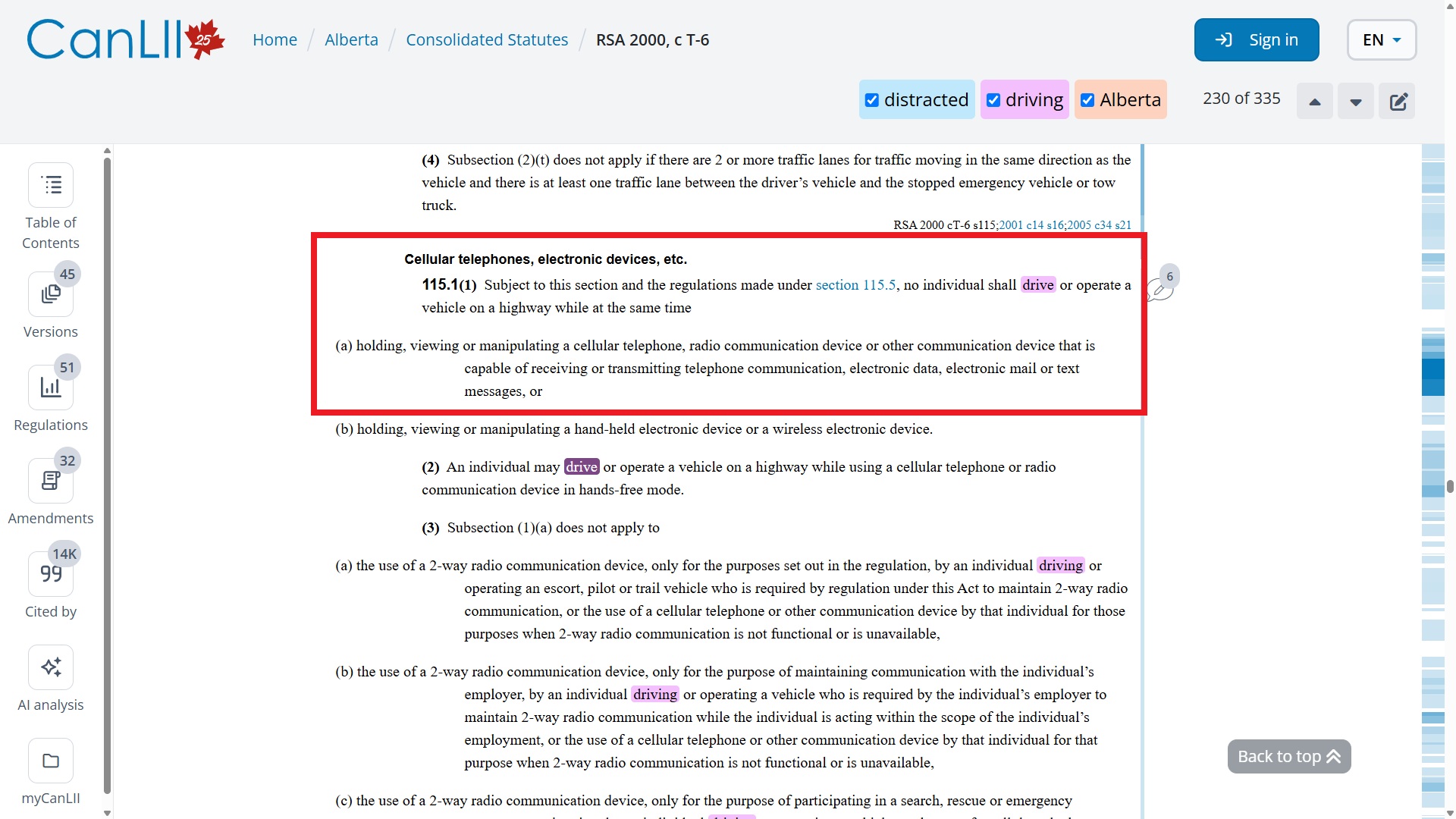
This is an excellent example of a primary source that can be relied upon for continued research. It is legislation that describes the law around distracted driving and explains that an individual is not allowed to hold or view a cellular device while driving.
The next step is to look at any applicable cases that may be relevant to our case. By clicking on the bubble with the pencil beside section 115.1, it provides the option to view “citing documents” that may have referenced this section of the legislation.
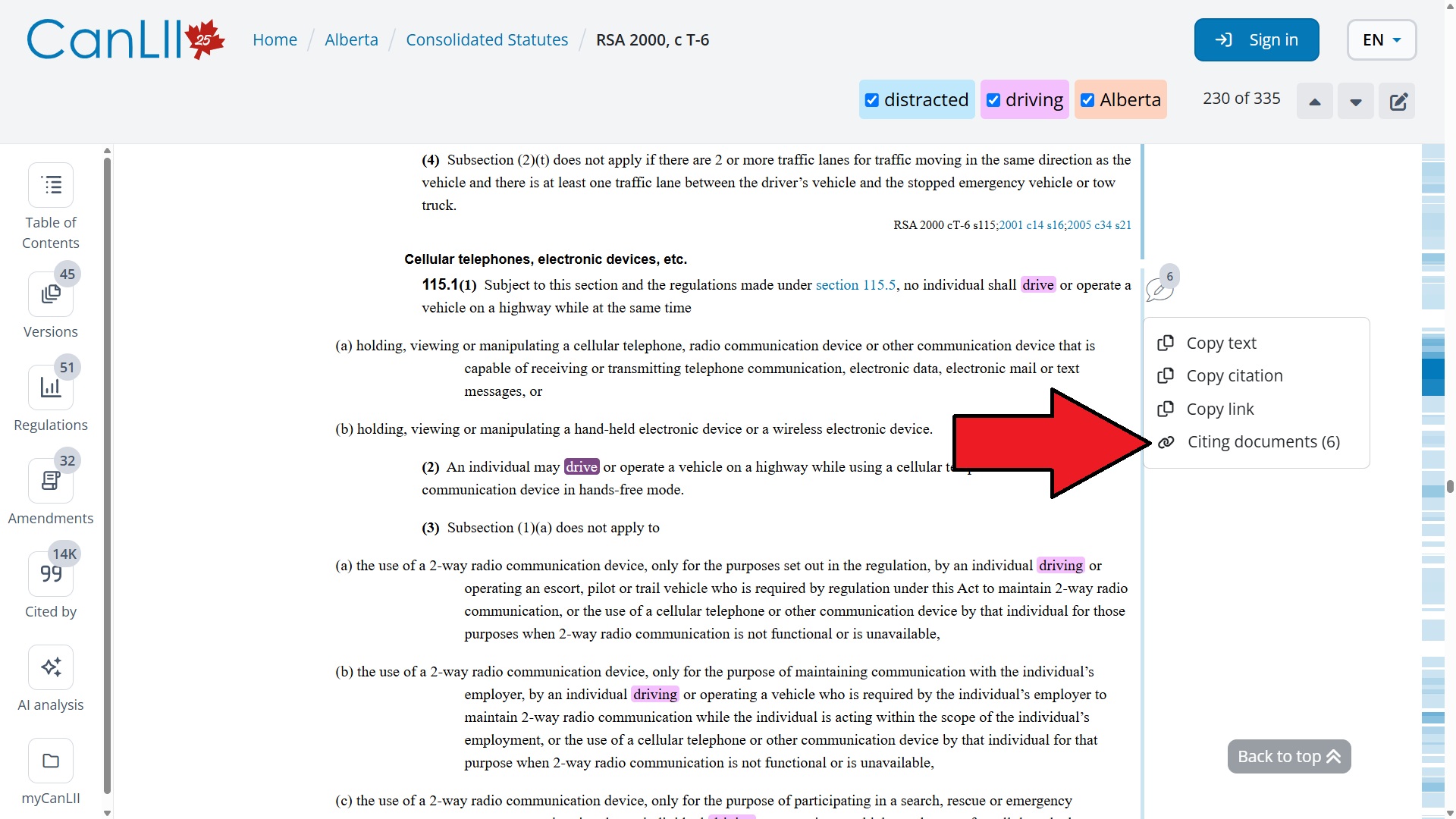
Clicking on this link will direct you to cases that have addressed the offence of distracted driving, particularly in relation to the use of a cellphone while operating a vehicle. Reading through these cases will help your legal research on how this section of the Act has been used in court. Finding cases that have similar facts to your case will support your argument and help form a defence.
Analysis
There are two cases that can be used to compare against our client’s case. The case of R v Ahmed, 2019 ABQB 13 and R v Gagne, 2019 ABPC 188. A table can be used to compare the facts and outcome of each case and how it relates to our client’s case for ease of understanding on what the likely outcome will be for our client.
| R v Ahmed, 2019 ABQB 13 | R v Gagne, 2019 ABPC 188 | Client’s Case | |
|---|---|---|---|
| Legal Facts |
|
|
|
| Outcome |
|
|
|
| Relation to our Client’s Case |
|
|
Both of the cases above demonstrate that the courts strictly interpret Section 115.1 of the Traffic Safety Act, which addresses the use of cellphones while driving. It states that any act involving the viewing or holding of a phone in any manner is prohibited and can result in a person being charged with distracted driving.
Conclusion
Our legal research indicates that the legislation and case law reviewed would most likely support our client being found guilty of distracted driving. The final step would be to write a legal memo or report that presents the information clearly and concisely, referencing all primary and secondary sources used, and then present it to the responsible lawyer.
Although this scenario was conducted in a step-by-step procedure, it is important to note that conducting legal research is not a linear process. Oftentimes, you may be unable to find cases that match the facts to your legal scenario. This results in finding cases that are similar but may have different facts. It also may result in having to use cases outside of your jurisdiction, which results in using persuasive cases instead of binding cases.
As stated above, legal research is not a linear process and can be challenging at times. It is important to know that there are resources available to assist you during your search. Some of these resources are listed below:
- Refer to your responsible lawyer for questions
- Contact a law librarian through the Law Library Legal Research Guides
- If self-representing, you can contact legal clinics/organizations near you as they can provide simple legal advice.
References
Blatt, A., & Kurtz, J. (2020). Legal research: Step by step (5th ed). Emond Publishing.
McCarney, M., Kuras, R., Demers, A., & Kierstead, S. (2016). The Comprehensive Guide to Legal Research Writing & Analysis (2nd edition). Emond Montgomery Publications.
R v Ahmed, 2019 ABQB 13.
R v Gagne, 2019 ABPC 188.