
Research Objectives and Process
Ashley McDonald; Isabella Evangelista; and Kris Ravelo
Upon successful completion of this chapter, learners will be able to do the following:
- Identify legally relevant facts from a client scenario and distinguish them from background or non-legal information.
- Frame a legal issue as a focused research question using relevant fact keywords and legal concept keywords.
- Use an organized legal research process to locate, assess, and communicate relevant primary and secondary sources in clear legal writing.
Identifying Research Objectives and Effective Research Steps
Legal Writing
Legal research is essential to inform clients accurately about their legal options and potential outcomes. It is also essential as it gives lawyers a reference on how the case may be interpreted by a judge based on previous cases and can help the lawyer decide whether or not to take the case and what their strategy could be if they decide to take the case.
Identifying Research Objectives (Planning)
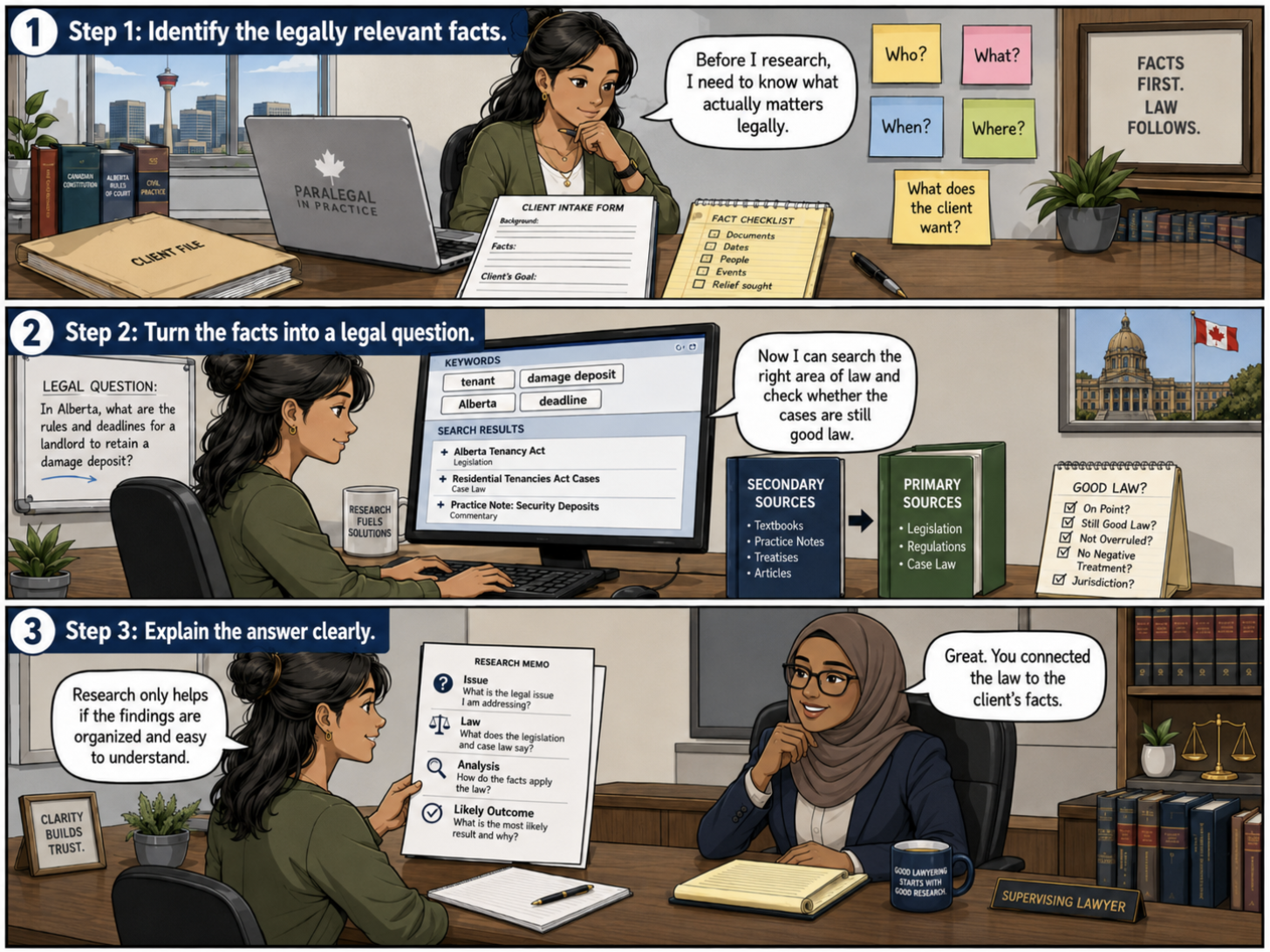
The first step in conducting legal research is to plan the research needed based on the legal issue presented. A factual analysis should be performed, which is the process of “extricating legally relevant facts from the mass of facts in a legal problem” (Fitzgerald, 2016, p. 9). The relevant facts raise a legal issue, simplifying the research process by focusing on only the relevant areas of law (Fitzgerald, 2016, p. 9). When gathering and organizing the relevant facts, Blatt and Kurtz (2020) suggest that it is important to consider the following:
- What are the legally relevant facts?
- The who, what, when, and where of the client’s claim
- What is the client asking?
- The client’s question on what they can do about their situation
- What area of law is relevant to the issue?
- Is it a general area of law or a specific area of law?
- What legal issues have been identified?
- Are there any keywords that helped you conclude this?
- What is the objective of the legal research task?
- Are there any hidden issues that need to be addressed?
- Issues that may not be obvious but are relevant to the situation
- Is any further information required?
- Does a follow-up with the client need to be conducted to gather more information?
Once the relevant facts have been identified, the next step is to frame the legal issues. McCarney et al. (2016) suggest framing the legal issue as a question and focusing on applying the law to the facts, as this will provide direction for conducting legal research. Legal concept keywords and fact keywords must be used to have a precise framing of the legal issue (McCarney et al., p. 2:9). Framing of the legal issue should follow the format of beginning with fact keywords (parties and where the claim took place), followed by legal concept keywords (causes of action) and finally ending with a question format that must be researched (McCarney et al., p. 2:9).
Once the legal issue has been framed, the next step is to begin legal research. When beginning legal research, it is beneficial to start with secondary sources such as legal articles, journals, digests, and encyclopedias (Blatt & Kurtz, 2020, p. 93). The secondary sources will lead to the primary sources (case law, legislation, regulations, and bylaws) that are of utmost importance to the legal research being conducted (Blatt & Kurtz, 2020, p. 93). The primary sources will be the evidence used in the client’s case. It is important to look for both binding and persuasive primary sources that favor the client’s case and go against your client’s case so that you can be prepared for every possible scenario (Blatt & Kurtz, 2020, p. 93). Ensure that the primary sources are still good law and are not outdated when conducting legal research (Blatt & Kurtz, 2020, p. 93). While doing legal research, keeping a checklist of what you have found is important. Some points to keep in mind are:
- What legislation and case law are relevant to the legal issues identified?
- How are these sources relevant?
- How does the law relate to the facts of the client’s situation?
Once the law has been applied to the client’s legal issues, you should be able to conclude the likely outcome of your case (Blatt & Kurtz, 2020, p. 94). Be sure to use the primary and secondary sources you have researched as evidence to support the likely outcome of the legal issue and the action that can be taken.
After the legal research has been completed, the next step is to communicate your findings in writing (Blatt & Kurtz, 2020, p. 288). Before you begin writing, draft an outline and plan your writing. The outline will give you a step-by-step guide to organizing your paper effectively, getting your point across, and increasing efficiency. Ellis (2022) suggests that when drafting an outline, it can be done in five steps as follows:
- Step one is to conduct research and gather evidence. The more research and evidence collected, the easier it will be to begin writing.
- Step two is to organize the research into topics that will help you see which information can be discussed together.
- Step three is to decide in what order the topics should be discussed in the paper to best convey your point.
- Step four is to fill in the gaps by adding where you want to put your sources, quotes, and any additional information that will help to support the paper.
- Step five is to review the outline and identify areas that need improvement or additional evidence to support the topic. Also, check whether the paragraph order makes sense or needs rearranging to better convey your point to the reader.
Drafting an outline will help you organize your research to get your point across (Ellis, 2022). It is also important to note that there is no official way to structure an outline; the format listed above is a standard to follow, but what matters most is that it makes sense to you and allows you to organize your research and findings in the best way possible (Ellis, 2022).
Once you are satisfied with the structure of your outline, the next step is to begin writing.
References
Blatt, A. & Kurtz, J. (2020). Legal Research: Step by Step (5th edition). Emond Montgomery Publications.
Ellis, M. (2022, September 26). How to Write an Outline in 5 Steps. Retrieved March 25, 2025, from https://www.grammarly.com/blog/writing-process/how-to-write-outline
Fitzgerald, M. F. (2016). Legal Problem Solving – Reasoning, Research and Writing: Reasoning, Research and Writing (7th edition). LexisNexis Canada.
McCarney, M., Kuras, R., Demers, A., & Kierstead, S. (2016). The Comprehensive Guide to Legal Research Writing & Analysis (2nd edition). Emond Montgomery Publications.