
Overview: Gall Bladder Sinew Channel (Leg Shaoyang)
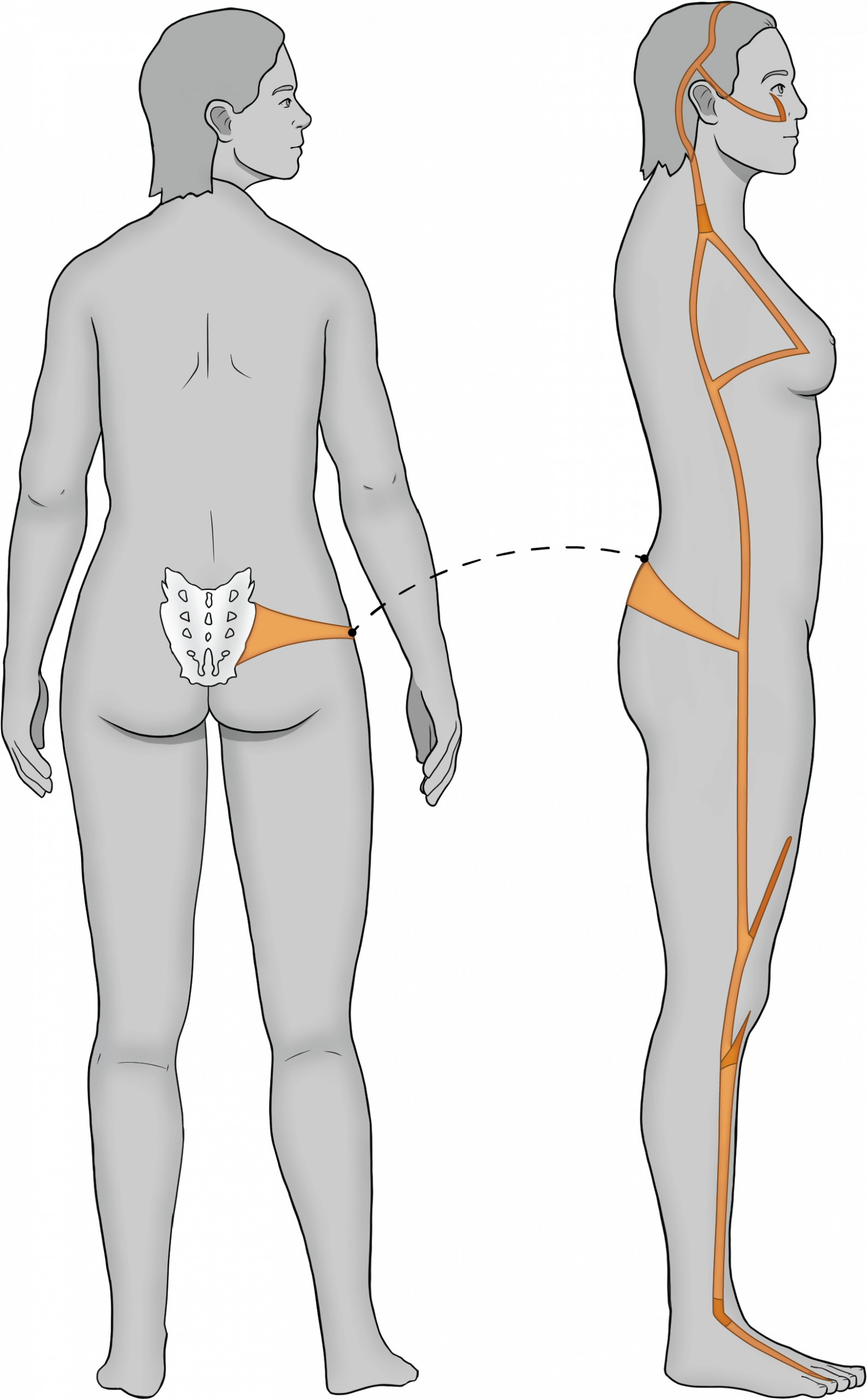
The Gall Bladder Sinew Channel: Trajectory and associated anatomy
- Begins on the lateral aspect of the foot on the fifth digit and travels posterior to the lateral malleolus following the peroneals to bind on the lateral aspect of the fibular head. (Anatomy: Abductor digiti minimi, Peroneus longus, and Peroneus brevis)
-
- anterior along with the tensor fascia latae (which is enveloped in the fascia of the Iliotibial band) to bind to the anterior superior iliac spine
- superiorly to the iliac crest
- posteriorly with the gluteus maximus and the deep lateral rotators to attach to the posterior aspect of the innominate and to the lateral aspect of the sacrumThe Gall Bladder sinew channel then continues up the lateral aspect of the thigh via the iliotibial band to the greater trochanter. From here it travels in three slightly different directions: (Anatomy: Iliotibial band, Tensor fascia latae, Gluteus maximus, Gluteus medius, Gluteus minimus, Piriformis, Deep lateral rotators (Quadratus femoris, Gemellus superior, Gemellus inferior, Obturator internus, Obturator externus))
- The main branch of the Gall Bladder sinew channel travels from its insertion on the Iliotibial band on the outer crest of the innominate to the attachment of the quadratus lumborum (QL) on the inner crest of the same bone. It travels up one side of the lumbar spine via the QL to attach to the inferior border of the 12th rib. (Anatomy: Quadratus lumborum)
- It then continues up the same side of the thorax via the intercostal muscles to connect to the sternocleidomastoid and bind at the mastoid process. (Anatomy: Intercostals and Sternocleidomastoid (SCM))
- The Gall Bladder sinew channel then continues around the posterior aspect of the ear to the corner of the forehead. From here, it travels downward to bind to the jaw via the temporalis and then to the cheekbone via the masseter. (Anatomy: Temporalis and Masseter)